Patience in Oak: What Happens When We Let Time Do the Brewing
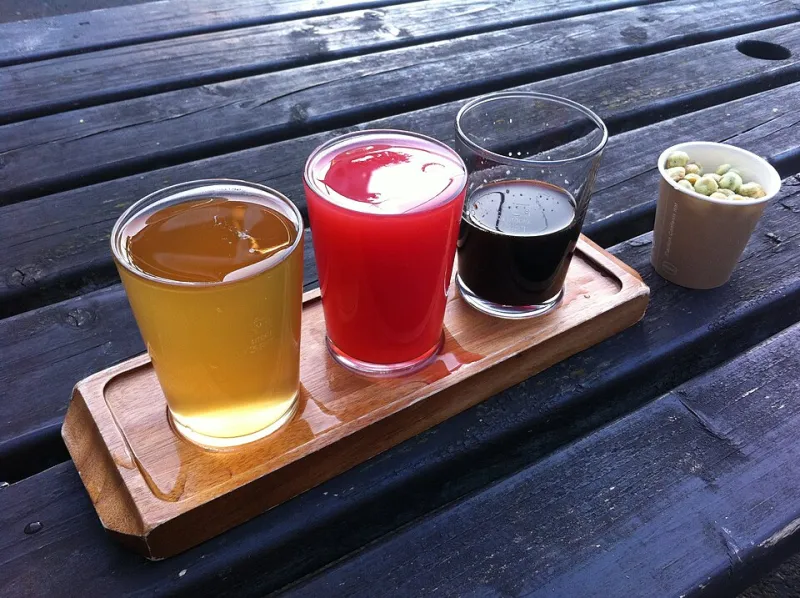
Photo: A J Paxton , CC BY-SA 2.0, via Wikimedia Commons
There's a door at the back of our production floor that most visitors never see. Past the fermenters, past the grain storage, past the hum of the canning line — there's a room that smells like a wine cave crossed with a whiskey distillery, and it's where some of our most interesting work quietly unfolds. This is the barrel room. And inside it, we're not really the ones in charge anymore.
Barrel aging is one of those processes that strips away a brewer's instinct to control everything. You fill a barrel, you seal it up, and then you wait. What comes out on the other side is the result of a thousand small decisions made long before that beer ever touched wood — and a handful of variables that no recipe can fully predict.
Why Barrels? Why Here?
The short answer is that oak does things to beer that stainless steel simply cannot. Barrels breathe. They allow tiny amounts of oxygen to interact with the liquid over time, softening harsh edges, coaxing out vanilla and caramel notes, and layering in whatever ghost flavors still linger from whatever spirit the barrel held before — bourbon, rye, red wine, brandy.
But the longer answer has everything to do with where we are.
Santa Maria sits in a valley that pulls cool marine air in from the Pacific almost every afternoon. That natural temperature swing — warm mornings, cool evenings — creates what our head brewer calls "a slow clock." The beer contracts and expands inside the oak with the daily temperature rhythm, drawing liquid deeper into the wood and then pulling it back out again. It's a cycle that accelerates flavor extraction without rushing the process into something harsh or unbalanced.
"We've talked to brewers in other regions who barrel-age in climate-controlled rooms," said our brewmaster. "That's totally valid. But out here, the environment is doing work for us. The coast has its own opinion about how the beer should taste, and honestly, we've learned to trust it."
A Year in the Room: Following Two Brews
Last January, we filled twelve barrels as part of our annual winter aging program. Half went into former bourbon barrels from a Kentucky distillery, and the other half went into Central Coast Pinot Noir barrels sourced from a vineyard about forty minutes up the road.
The base beer for both was a strong dark ale — roasty, with a backbone of dark fruit and a finishing ABV around 10%. On its own, it's a solid sipper. In a barrel, it becomes something else entirely.
Months one through three are mostly about waiting and checking. We pull small samples every few weeks, just a few ounces, to monitor how the oak is interacting with the beer. In the early stages, the bourbon barrels deliver big, bold vanilla and a coconut-like sweetness. The Pinot barrels are more reserved at first — earthy, a little tannic, hints of dried cherry slowly emerging.
By summer, the picture gets more interesting. The bourbon-aged ale has started to mellow. What was initially almost too sweet has rounded out into a deep, caramel warmth with a slight smoky finish. The Pinot barrels, meanwhile, have opened up considerably. There's a tartness developing — not sour, but bright — alongside notes of dark chocolate and fig. The Central Coast's warm afternoons are doing their thing.
Come fall, we're tasting in earnest and making decisions. Some barrels are ready. Some need more time. A few get pulled and blended together to create something greater than either barrel could produce alone. This is where brewing starts to feel more like winemaking — where intuition and experience matter as much as any data point.
The Decisions Nobody Talks About
Barrel aging gets romanticized pretty easily, and we get it. The imagery is great. But the reality involves a lot of unglamorous judgment calls.
Some barrels go wrong. A small percentage develop off-flavors — vinegar notes from unwanted acetic acid, or musty characteristics from a barrel that wasn't properly cleaned before filling. When that happens, the beer doesn't make it to the tap. It's a hard call to dump months of work, but protecting the integrity of what we put out matters more than recouping the time invested.
Then there's the blending question. Do you release a barrel-aged beer as a single-barrel expression, where every nuance of that specific barrel shines through? Or do you blend multiple barrels to create something more consistent, more balanced, more reliably delicious? We do both, depending on the beer. Our single-barrel releases are intentionally limited — sometimes just a few cases — and they're labeled with the barrel number and fill date. They're for the folks who want to geek out on the specifics.
The blended releases are for everyone else. More approachable, still complex, and designed to taste great whether you're pairing it with a slow-smoked tri-tip at a backyard cookout or sipping it on its own after a long week.
What the Central Coast Water Brings to the Table
Water chemistry doesn't get enough credit in these conversations. Santa Maria's water profile — relatively soft, with low mineral content — is a genuine asset for barrel aging. High mineral content can amplify certain flavors in ways that clash with oak extraction. Our water lets the barrel do its job without competing for attention.
We do adjust our water chemistry depending on the base beer style, but for our barrel-aging program, we tend to keep things closer to natural. The softness of the water allows the oak character to come through cleanly, and it keeps the mouthfeel on those big, boozy barrel-aged beers from getting heavy or astringent.
Tasting Notes: What to Expect
If you haven't tried a barrel-aged beer from our lineup yet, here's a quick guide to what you're walking into:
- Bourbon Barrel Dark Ale: Think dark chocolate, toasted vanilla, a whisper of smoke, and a warmth that settles into your chest. Best served slightly above fridge temperature — around 50–55°F — in a snifter or tulip glass.
- Pinot Barrel Reserve: More nuanced, more wine-forward. Dried cherry, cocoa, a gentle tartness, and a finish that lingers in a good way. Pairs beautifully with aged cheese or anything with a little char on it.
Both are released seasonally, and both tend to sell out faster than we'd like. If you're on our email list, you'll get first access.
Why We Keep Doing This
Barrel aging is expensive, time-consuming, and inherently risky. So why do it?
Because it produces beers that couldn't exist any other way. Because the Central Coast gives us a climate that's genuinely suited for this kind of work. And because there's something deeply satisfying about opening a barrel after eleven months, pouring a small glass, and tasting something that surprised even the people who made it.
That's the part of brewing that keeps us showing up. Come by and taste it for yourself.