Small Batch, Big Soul: Why Staying Rooted Makes Us a Better Brewery

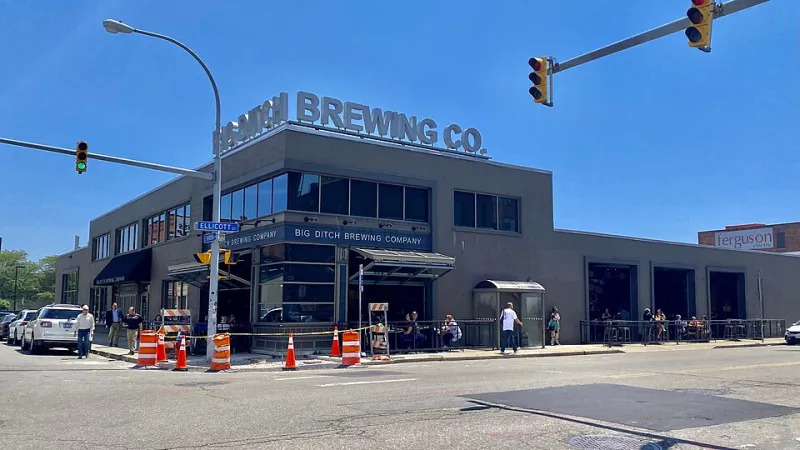
Photo: Eric Jones, CC BY-SA 2.0, via Wikimedia Commons
Somewhere along the way, the craft beer world started treating growth like the only valid goal. More taps, more distribution, more square footage, more SKUs on more shelves in more states. And look — there's nothing wrong with ambition. But here at Santa Maria Brewing Co., we've come to believe that a certain kind of restraint is actually its own form of ambition. Staying deliberately rooted in one place, at one manageable scale, has turned out to be the most creatively liberating decision we've ever made.
This isn't a story about playing it small. It's a story about playing it smart.
The Constraint That Sets You Free
When you're running a national operation, every decision gets filtered through a hundred layers of logistics, shelf-life projections, and mass-market palatability. You're not really brewing for a person anymore — you're brewing for a demographic. And somewhere in that process, the soul of the beer has a tendency to get quietly squeezed out.
Our production constraints work differently. Because we're not chasing volume, we can chase curiosity. We can ask, what happens if we dry-hop this with a local herb from a farm twenty minutes up the road? We can pull a batch, taste it, and pivot in a way that a 200,000-barrel operation simply cannot. The small-batch format isn't a compromise — it's a creative sandbox, and we've learned to love playing in it.
When a brewer here has an idea, that idea can go from conversation to conditioning tank in a matter of weeks, not quarters. That speed — that creative agility — is something money genuinely cannot buy at scale. It's baked into our size.
What It Means to Actually Know Your Drinkers
Here's something that gets lost in the national brewery conversation: when you're big enough to be everywhere, you stop being anywhere in particular. You lose the texture of a real place and the faces of real people.
We know our regulars. Not in a vague, demographic-profile kind of way — we know their names, their preferences, the occasions they're celebrating when they walk through the door. When someone tells us they want something more sessionable for summer afternoons at the beach, that feedback doesn't disappear into a survey database. It ends up influencing what we actually brew next.
That feedback loop between brewery and community is one of the most underrated advantages a regional craft brewery has. It's direct, it's honest, and it makes the beer better. A macro-brewery can spend millions on consumer research and still miss what we pick up in a single Saturday afternoon conversation at the taproom.
The Central Coast Gives Us What No Supply Chain Can
There's also the matter of where we are. Santa Maria sits in one of the most agriculturally rich corridors in the entire country. The Central Coast produces strawberries, wine grapes, hops, honey, stone fruit, and more — much of it grown within a short drive of our brewery. That proximity is not incidental to what we do. It's fundamental.
A large national brewery sources ingredients from wherever the contract is most economical. We source from neighbors. We can visit the farms, shake the hands of the people growing our adjuncts, and build relationships that inform the beer in ways that a purchase order never could. When you use a local honey variety that's only available in a short seasonal window, the resulting beer carries something irreplaceable — a specificity of place that no amount of branding can manufacture.
Staying rooted in Santa Maria means we're constantly working with what the land and the season actually offer us. That's not a limitation. That's an identity.
Growing Deliberately Is Still Growing
None of this means we're standing still. Deliberate growth and stagnation are two very different things, and we'd push back hard on anyone who conflates them. We're investing in equipment, expanding our barrel program, refining our processes, and developing new recipes every season. We're growing — just on our own terms.
The difference is that our growth decisions are driven by what makes the beer better and what deepens our connection to this community, not by what maximizes distribution reach or satisfies an investor's quarterly expectations. When we add a new fermentation vessel, it's because we want to explore a style we haven't had the capacity to do justice. When we open up a new event series, it's because we want more people to have a reason to gather here.
That kind of intentionality produces a different result than growth-for-growth's-sake. You can taste it.
The Case for Staying Mid-Sized
The craft beer conversation tends to celebrate two extremes: the scrappy two-person nano-brewery running on passion and a prayer, or the massive regional juggernaut that's basically a mid-sized corporation wearing a flannel shirt. Both have their place. But there's something genuinely powerful about the middle ground — the brewery that's big enough to have real craft and real consistency, but small enough to stay curious and community-connected.
That's where we live. We have the infrastructure to brew with precision and the flexibility to experiment without catastrophic risk. We have enough regulars to sustain a real conversation about what people want, and enough creative bandwidth to surprise them anyway.
At this scale, every beer still feels like a decision made by people who care. Not a formula approved by a committee.
Why We're Not Chasing the Exit
Every few years, another well-loved regional craft brewery gets acquired by a macro player, and the community that grew up around it holds its breath waiting to see what survives the transition. Sometimes things are mostly fine. Often, something essential quietly disappears.
We're not interested in that path. Not because we're romantic about independence for its own sake, but because the independence is actually what makes the work interesting. The ability to take a risk on an unusual grain bill, to release a beer that only makes sense if you know the farm it came from, to brew something purely because it's the right thing to drink on a warm Central Coast evening — that's the whole point.
Staying rooted in Santa Maria isn't a consolation prize for not scaling up. It's the strategy. And every pint we pour is evidence that the strategy is working.